


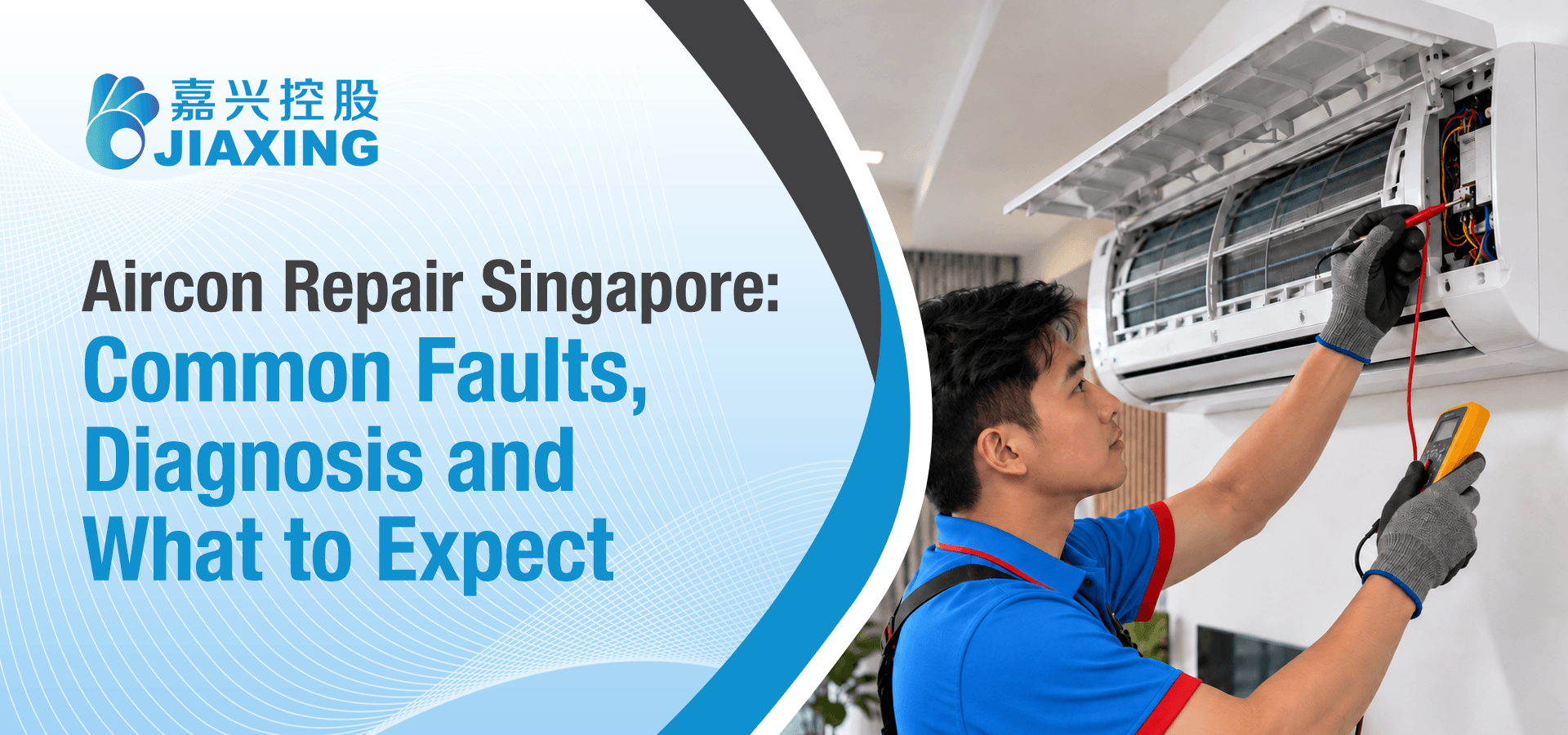
13 Nov Aircon Repair Singapore: Common Faults, Diagnosis and What to Expect
Aircon repair in Singapore involves diagnosing and fixing faults that cause poor cooling, water leaks, unusual noise, blinking lights or unexpected shutdowns. The right solution may involve drainage work, electrical repair or replacement of a faulty part. A professional inspection helps distinguish these faults from cleaning needs and confirms whether the system can operate safely.
When your aircon stops working properly, it is tempting to assume it needs more gas or a chemical wash. However, similar symptoms can come from very different problems. Understanding what to observe and what a repair appointment involves helps you explain the issue and make an informed decision about the next step.
Stop using the aircon if you notice a burning smell, repeated breaker trips or water leaking near electrical fittings. Avoid repeatedly restarting it. Arrange professional assistance, and treat an actual fire or immediate danger as an emergency. If your aircon keeps tripping the circuit breaker, the underlying cause needs investigation.
Table of Contents
What Common Aircon Faults Need Professional Attention?
Poor cooling, indoor water leaks, weak airflow, unusual noises, recurring error indications and unexpected shutdowns are reasons to arrange an inspection. These symptoms do not identify the faulty part on their own. A technician needs to check the system to determine whether cleaning, drainage work, electrical repair or another solution is appropriate.
| What you notice | Possible causes | What a technician checks |
| Air blows but the room stays warm | Incorrect settings, dirty coils, refrigerant problems, sensor or equipment faults | Operating mode, airflow, coil condition and relevant system readings |
| Water drips from the indoor unit | Blocked drainage, tray damage, insulation problems or a freezing coil | Drainage route, water discharge, tray, insulation and signs of ice |
| Airflow becomes weak | Dirty filters, a clogged blower or coil, or a fan problem | Air passages, internal contamination and fan operation |
| Unit will not start or shuts down unexpectedly | Remote or timer settings, power or control issues, or protective shutdown | Symptom history, settings, fault indications and electrical condition |
| Lights blink or an error code appears | A model-specific warning, maintenance indication or system fault | Exact model, indicator meaning and the associated diagnostic checks |
| New or persistent abnormal noise | Loose components, vibration or worn fan-related parts | Where the sound comes from and when it occurs |
| Ice forms on the unit or pipe | Restricted airflow or a refrigerant-related operating problem | Coil condition, airflow and appropriate system tests |
| Musty smells keep returning | Contamination, retained moisture or drainage problems | Coil, blower, drain tray and drainage condition |
A room that feels warm despite strong airflow presents a different clue from a unit that barely blows air. Both can be described as an aircon not cold problem, but the checks and recommended work may differ.
Likewise, aircon leaking water does not always mean the drain pipe is blocked. A damaged tray, insulation issue or frozen coil may also be involved. Clearing a blockage will not resolve a separate fault elsewhere in the system.
What Can You Check Before Booking Aircon Repair?
Before booking, check the remote batteries, cooling mode, temperature setting and timer. Note any error indication, obvious indoor airflow obstruction and whether other rooms are affected. These observations can help identify a settings issue and guide the technician, but they cannot confirm the condition of internal electrical parts or the refrigerant system.
Check the Remote and Room Conditions
Make sure the controller is set to the intended cooling mode rather than fan-only operation. Check whether a timer has been activated or the selected temperature has changed. Open windows, strong afternoon sunlight and newly added heat-producing equipment can also affect how quickly a room cools.
If everything is set correctly but cooling remains noticeably different from normal, arrange an assessment rather than repeatedly lowering the temperature.
Distinguish a Restart Delay from a Breakdown
Some air conditioners briefly delay restarting to protect the equipment. Fan speed may also change as the room approaches the selected temperature. A short pause or change in airflow does not automatically indicate a fault.
Daikin’s troubleshooting guidance explains examples of protective restart behaviour. Follow the instructions for your specific model, as operating behaviour varies. A persistent error, repeated shutdown or failure to restore cooling still needs attention.
Leave Internal Work to Professionals
Keep your checks to settings and safe observations. Internal cleaning, drainage work, electrical testing and refrigerant handling should be left to qualified professionals. Avoid opening electrical covers, spraying cleaning products inside the unit or accessing the outdoor aircon ledge. Incorrect handling can damage components and create additional problems.
Why Is Only One Room’s Aircon Affected While the Others Still Work?
In a multi-split system, several indoor units share an outdoor unit. A problem in one room may involve that indoor unit, its controls or another part of the connected system. The affected-room pattern helps narrow the investigation, but it does not prove which component has failed or rule out a shared-system issue.
Many HDB flats and condominiums use multi-split arrangements, often described as System 3 or System 4. Tell the technician which rooms are affected and whether the symptoms started together.
| What happens | Useful details to share | What needs to be distinguished |
| One room stops cooling | Which unit, its settings and any error indication | A local airflow or control problem versus another connected-system issue |
| Several rooms develop problems together | Whether they share an outdoor unit and when the problem started | Shared power, outdoor equipment, controls or another common issue |
| Cooling weakens when more rooms run | Which units are operating and whether this behaviour is new | Available cooling capacity and room conditions versus an equipment fault |
For example, one warm bedroom does not automatically mean its indoor circuit board needs replacement. Similarly, several warm rooms do not confirm compressor failure. The technician must consider the system configuration and test the relevant components before recommending work.
Does Your Aircon Need Servicing, Chemical Cleaning or Repair?
The appropriate work depends on the cause of the problem. Dirt-related airflow or drainage issues may need professional cleaning, while damaged components need repair or replacement. Some systems require both. An inspection helps identify the work needed instead of choosing a chemical wash, gas top-up or new part based only on the symptom.
| Type of work | Main purpose | When it may be appropriate |
| General servicing | Routine cleaning and condition checks | Maintaining a functioning system and addressing routine contamination |
| Chemical cleaning | Deeper cleaning where the unit’s condition justifies it | Stubborn internal buildup affecting airflow, drainage or cleanliness |
| Aircon repair | Correcting an identified fault | Damaged parts, electrical or control problems, leaks or other confirmed defects |
A chemical wash cannot repair a failed control board. Equally, replacing a component will not remove a separate drainage blockage. Our guide to aircon servicing vs repair explains the differences in more detail.
Refrigerant also need careful diagnosis. It circulates within a closed system and should not need routine replenishment under normal conditions. If refrigerant is genuinely low, the reason needs investigation. Understanding gas top-up versus leak repair helps explain why adding gas alone may not resolve recurring cooling problems.
What Happens During Professional Aircon Repair?
A professional repair appointment starts with understanding the reported problem, followed by inspection and testing. The technician explains the findings and recommended work before proceeding with your agreement. Once the work is completed, the relevant operating checks help establish whether the original fault has been addressed or further investigation is needed.
1. Understand the Fault and Service History
The technician will ask when the problem started, whether it happens continuously and which units are affected. Previous servicing, repairs, gas top-ups or installation work can provide useful context.
Be specific where possible. “The bedroom unit stops after running for a while” is more helpful than “the aircon is spoiled.” Explain what you noticed without feeling that you need to name the faulty part.
2. Inspect and Test the Relevant Components
Depending on the symptoms, checks may involve the filters, evaporator coil, blower, drainage, outdoor unit and electrical controls. Testing may also cover refrigerant-system performance, sensors, wiring, the control board or fan operation.
The findings need to be considered together. An error code points towards an area requiring investigation, rather than automatically confirming which part should be replaced. Likewise, a pressure reading needs to be interpreted alongside the system’s operating conditions and other relevant checks.
3. Explain the Findings and Recommended Work
Before work proceeds, you should understand what was found, what needs attention and whether suitable replacement parts are required. Ask the technician to explain any uncertainty, additional testing or limitations.
The recommendation may involve drainage rectification, electrical or control repairs, leak repair, cleaning or component replacement. The solution should follow the diagnosis rather than a standard treatment applied to every problem.
4. Carry Out the Repair and Verify Operation
After completing the agreed work, the technician checks the relevant functions. A water-leak repair needs drainage verification, while a cooling complaint needs checks related to airflow and cooling operation.
Some repairs can be completed during the appointment. Others require suitable parts, additional access or further testing. Jiaxing’s aircon repair services in Singapore include fault diagnosis and troubleshooting for residential and commercial customers.
What Should Be Checked After an Aircon Repair?
After a repair, the checks should relate to the original complaint and the work completed. The unit starting successfully is only one part of verification. Cooling, airflow, drainage, controls or operating sound may also need assessment, depending on the fault. Ask what was tested and whether any follow-up work remains.
Before the appointment ends, clarify:
- The findings: What caused the reported problem?
- The work completed: What was repaired, cleaned or replaced?
- The verification: Which operating checks were carried out?
- Any limitations: Does anything need further investigation or another visit?
- The coverage: What parts or workmanship terms apply to this particular repair?
- The next step: What should you observe, and who should you contact if the issue returns?
What If the Same Problem Returns?
Keep the service record and contact the repair team with the symptoms and timing. Explain whether the issue returned immediately or after several days, and whether it happens under the same operating conditions.
A recurring symptom does not always mean the same component has failed again. Further assessment may be needed to distinguish the original issue from another fault. Stop using the aircon if there are danger signs, and do not keep restarting it simply to reproduce the problem.
For ongoing care, arrange maintenance according to usage and system conditions. Our guide explains when to book professional aircon maintenance and which warning signs deserve earlier attention.
What Information Should You Prepare Before Booking For Aircon Repair in Singapore?
Prepare a clear description of the symptom, the affected room or unit, and when the problem started. Include the brand, model and any error indication if available. Previous repair records and access information can also help the team plan the visit. You do not need to identify the faulty part before contacting us.
Useful details include:
- Aircon brand and model, from existing records or a safely readable label.
- Which indoor units are affected and whether the others still work.
- Whether the problem is constant or intermittent.
- When it happens, such as shortly after startup or only after extended operation.
- Any existing error code, photograph or safely recorded video.
- Previous servicing or repair details.
- Property type and relevant building-management or access arrangements.
Do not climb to reach a label or restart an unsafe unit to record evidence. If you need emergency aircon repair for your home or office, describe the urgent symptoms when contacting the team so the appropriate next step can be discussed.
Frequently Asked Questions
Can an Aircon Repair Be Completed in One Visit?
Some faults can be diagnosed and resolved during one appointment. Other repairs require suitable replacement parts, additional access or further testing. The technician can explain the expected next steps after assessing the system. A straightforward-looking symptom does not always mean the underlying repair is simple.
What If My Aircon Works Normally When the Technician Arrives?
Intermittent faults may not appear during every visit. Share when the problem happens, how long the unit has been running and whether other units are operating. Existing videos, error indications and service records can help guide testing, although they may not confirm the cause on their own.
Should I Contact the Manufacturer If My Aircon Is Still Under Warranty?
Check the applicable warranty terms with the manufacturer or installer before authorising repair work. Explain the symptoms and ask about the correct assessment process. Coverage and repair arrangements vary, so avoid assuming that every component or type of work is included.
Do I Need to Know Which Part Is Faulty Before Booking?
No. Describe what the aircon is doing and when the issue occurs. The purpose of professional diagnosis is to establish the cause and recommend suitable work. Requesting a gas top-up or a specific replacement part before inspection may overlook another explanation for the symptom.
Is Office Aircon Repair the Same as Home Aircon Repair?
The diagnostic principles are similar, but the work can differ. Offices may use cassette, ducted or larger connected systems with different controls and access requirements. Share the system type, affected areas and operating arrangements when booking so the required assessment can be discussed.

Get Your Aircon Fault Properly Checked with Jiaxing
Aircon not cooling, leaking or shutting down unexpectedly? Arrange a professional inspection with Jiaxing Aircon. Our team can assess the symptoms, explain the findings and recommend the appropriate repair or servicing for your system. Share your aircon brand, the affected unit and what you have noticed so we can help you arrange the next step.
Sorry, the comment form is closed at this time.